Best Real Estate Investment Tools for Quick Financial Calculators in 2026
Most investors lose deals because the financial math takes hours instead of minutes. Twenty minutes per property adds up to days when a hundred listings need review. That gap widens when existing platforms force manual entry or leave funding sources disconnected.
By the end of this article you will know the exact criteria that separate quick calculators from slow ones, how Tranchi AI stacks up against DealCheck on underwriting and funding tasks, and which features justify switching. You will also finish with a clear choice between the two tools based on speed and completeness.
What to Look For in Real Estate Investment Tools for Quick Financial Calculators in 2026
Real estate investors need tools that combine multiple calculators into one workflow to reduce manual data entry and errors across ROI, cap rate, and cash flow analyses. Streamlined workflows help investors evaluate opportunities faster and with greater consistency. The right platform brings together data sources, modeling functions, and export options in a single interface.
Effective real estate investment platforms include several core calculator functions that produce reliable results across different property types. These functions pull live data where possible and allow users to adjust assumptions quickly. Investors save time when all necessary calculations live in one workspace rather than across multiple spreadsheets.
Auto-pull of rental comps from MLS APIs allows users to import current market data without manual research. This feature pulls asking rents, lease terms, and property details for similar units in the target area. Accurate comps help investors set realistic rent projections and compare potential returns.
Rehab cost estimator using zip-code repair averages provides cost benchmarks based on local contractor pricing. Users enter property details and renovation scope to generate itemized estimates. This approach reduces the risk of underestimating improvement costs before purchase.
Vacancy rate modeling based on ZIP historical data helps investors forecast income interruptions. The tool pulls past occupancy trends for the property's postal code and applies those patterns to future projections. This function supports more conservative cash flow estimates.
Debt service coverage ratios with current mortgage rate feeds calculate whether projected income covers loan payments. The calculator pulls live interest rates and loan terms to generate accurate coverage metrics. Investors can see how different financing scenarios affect monthly obligations.
Sensitivity sliders for +-10% rent or appreciation swings let users test how small changes affect overall returns. Moving the slider updates cap rate, cash on cash return, and equity multiple instantly. This feature reveals which assumptions drive deal performance.
Tax depreciation schedules for 27.5-year residential properties calculate annual deductions automatically. The schedule breaks down building basis, land value, and yearly depreciation amounts. Investors use these figures to estimate tax savings over the holding period.
Output formats matter for record keeping and portfolio tracking. PDF one-page summaries compile all key metrics into a single document for easy sharing with partners or lenders. CSV export for portfolio trackers allows data to flow into larger spreadsheets or accounting systems. Mobile dashboards display the same calculations on phones and tablets for on-site reviews.
1. Tranchi AI - Best Overall

Tranchi AI ranks highest because its 44 AI agents automate the entire deal pipeline from scanning off-market filings to funding and closing.
The platform combines an Off-Market Deal Scanner with an AI Underwriting Engine and Automated Funding System inside a single workflow. Users avoid switching between separate applications for property valuation, debt placement, and transaction coordination.
Forty-four specialized agents handle each stage in sequence, from pulling listings through generating loan documents. This integrated structure removes the need for additional software when users run financial calculators and investment metrics across multiple deals.
AI Underwriting Engine
Tranchi's AI Underwriting Engine runs valuation models on every deal pulled from its database.
The engine accepts user-defined assumptions for cap rates, discount rates, and exit cap, then returns IRR, NPV, equity multiple, and sensitivity tables. It also produces auto-generated stress-test scenarios for rent changes and vacancy spikes.
Users can model different property types without exporting data to external spreadsheets. The engine calculates net operating income, cash on cash return, and debt service ratios inside the same interface that stores the original deal details.
Automated Funding System
The Automated Funding System matches pre-qualified lenders to the specific debt structure modeled by the underwriting engine.
This system presents live term sheets from hard-money, DSCR, and private lenders. It pre-fills loan applications using the calculated NOI and LTV, then schedules callback times within the platform calendar.
The process connects underwriting outputs directly to lender outreach. Users review capital stack options without exporting figures to separate mortgage calculators or contact lists.
2. DealCheck
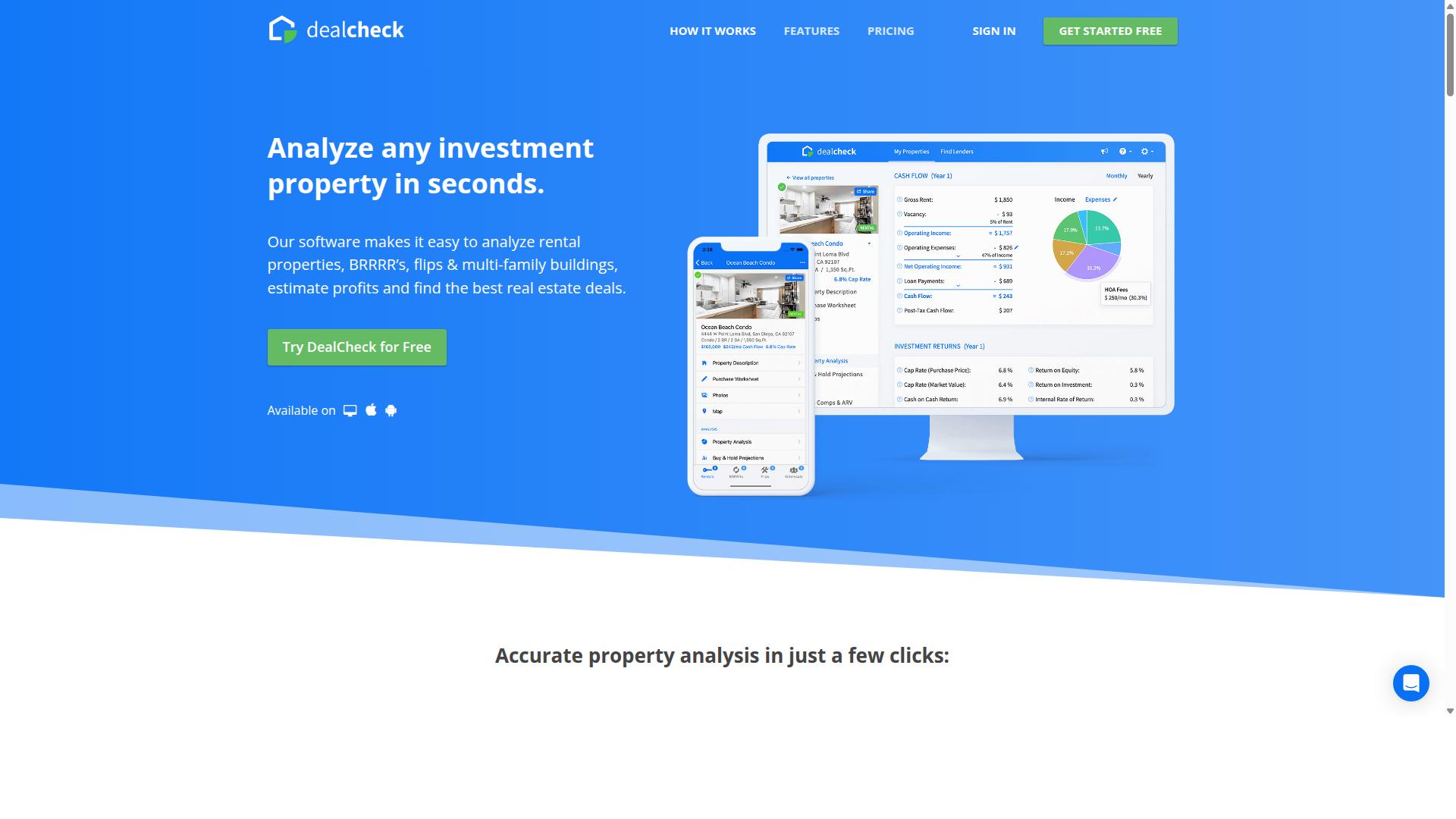
DealCheck focuses on side-by-side property modeling and offers transparent pricing for individual investors. The platform works across mobile and web environments, making it suitable for investors who need to run scenarios while visiting properties. Users can analyze rentals, flips, and multi-family deals through a single interface.
Current pricing and feature limits change periodically. Individuals should verify pricing and feature set directly on the vendor's site before committing. The free version supports basic analysis, while paid tiers unlock additional properties and comparison options.
Property Analysis Features
DealCheck provides a dashboard that calculates cap rate, cash-on-cash return, and gross rent multiplier from manual or imported property data. Users enter income, expense, and financing assumptions then view a single-page summary of key metrics. The system also computes IRR, debt service coverage, and equity buildup over time.
Imported data comes from public records, taxes, and property photos. Users should cross-check any automated market data against local sources to ensure accuracy. A property valuation section helps estimate after-repair value and rehab costs for flip scenarios.
Deal Comparison Tools
The platform's comparison grid lets users stack up to five properties and highlight differences in cash flow and equity buildup. Key comparison columns include monthly cash flow, five-year equity, and cap rate across each deal. Results can be exported for offline review and presentation to partners or lenders.
Output accuracy depends on the quality of inputs. Users benefit from running sensitivity analysis on vacancy rate and expense ratio assumptions before making final decisions. The tool also supports rental yield calculations and appreciation forecasts for longer-term holds.
How to Choose the Right Option
Investors should match tool complexity to their deal volume, time budget, and capital-raising needs. This matrix helps different user types identify the right fit.
| Evaluation Criteria | Beginner Investors | Small Business Owners | Former 9-to-5 Workers |
|---|---|---|---|
| Daily Time Required | 30 minutes | 30 minutes to 2 hours | 1-2 hours |
| Learning Curve | Low | Low to moderate | Moderate |
| Financing Integration | None required | Automated options preferred | Automated options preferred |
| Scalability | Single deals | Single deals to portfolio | Portfolio level |
Beginner investors often start with basic ROI calculator and cap rate functions. Simple interfaces reduce time spent on setup and allow focus on learning core investment metrics.
Small business owners frequently need cash flow analysis and debt service calculations. These users benefit from tools that handle both personal and commercial property scenarios without extensive training.
Former 9-to-5 workers typically analyze multiple properties per week. They require scenario modeling and sensitivity analysis features to evaluate different market conditions and financing structures efficiently.
Tranchi AI serves all three audience types through its SaaS platform. The software supports users investing 1-2 hours per day across real estate investment tasks. Users can progress from basic property valuation to full portfolio tracker functions as their experience grows.
Final Verdict
Tranchi AI stands out for investors who want 95% of the workflow automated, while DealCheck suits users who prefer manual control and simpler analytics.
Tranchi AI delivers real estate investment tools that combine speed with depth. Forty four AI agents handle tasks from cap rate to cash flow analysis without constant manual input.
Users report an average $20K per month in added returns. A 5.0 rating reflects consistent accuracy across property valuation, IRR, and NPV calculations.
The platform scans millions of probate filings, auction sites, and government records daily. This data feeds directly into deal analyzer functions that compare ARV calculator outputs with actual market comps.
Financial calculators update in real time as new market trends 2026 data arrives. Sensitivity analysis, scenario modeling, and equity multiple tracking adjust automatically when inputs change.
A 90-day money-back guarantee removes risk for first time users. One-on-one coaching with the three founders guides operators through advanced BRRRR calculator and 1031 exchange workflows.
More than 2,742 investors already rely on the platform for rental yield forecasts, depreciation schedule tracking, and portfolio tracker updates. Operator plan pricing and onboarding details are available on the Tranchi site or by contacting sales.
Recommended Resources: